 Semiconductor & Hardware Correspondent
The tensions across the Taiwan Strait have global tech implications not because semiconductors have been imbued with dramatic symbolism, but because advanced chip manufacturing capability has long been concentrated in Taiwan, fundamentally changing how the 外部[2][5] As this capability begins to disperse overseas, the question shifts from 'how many chips Taiwan holds' to 'how concentrated those chips remain'—this is why every step of TSMC’s overseas expansion must be reassessed. Such changes are not visible in a single 季度 In Taipei, perceptions often feel more immediate than statistics: a factory is not just a factory, it is also an anchor point for the supply chain.[1][4]
At least in academic research, this question is no longer just metaphorical. Recent studies on Taiwan's semiconductor industry and geopolitics have incorporated scenarios including blockade, isolation checks, and full-scale invasion, highlighting supply chain[2] Another set of discussions about Taiwan’s strategic choices considers the “silicon shield” as a concept that thins as capacity moves abroad—because when advanced manufacturing is no longer solely concentrated on the island, the external world's reliance on Tai Another set of discussions about Taiwan’s strategic choices considers the “silicon shield” as a concept that thins as capacity moves abroad.[1][10]
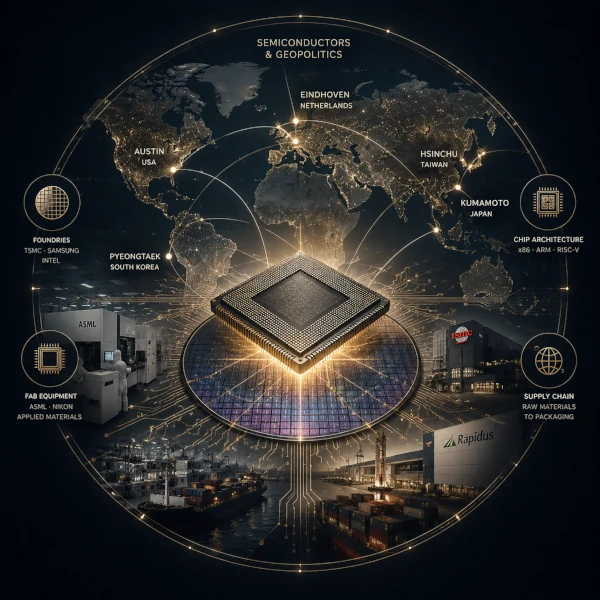
TSMC’s overseas factory builds are the most tangible visible aspect of this thinning process.[9] The company has publicly stated that its first Arizona plant will produce the N4 process node, while its second will target 3nm manufacturing; simultaneously, expansions in Kumamoto, Japan, and Europe place capacity closer to different end markets.[9][7] From a corporate standpoint, this is a trade-off among customer diversification, policy subsidies, and supply resilience; from Taiwan’s perspective, it means that high-end manufacturing capacity no longer carries exposure only to island risks, but starts to
The issue is that what is shared is not just risk but possibly strategic value as well. External analyses estimate Taiwan-related logistics costs could rise between 15% and 22%, and that advanced capacity will remain difficult to fully replace in the near term—at least until around 2028.[1][4] These figures require cautious interpretation, because they depend on different baselines, scenarios, and supply chain layers; yet they remind us that overseas buildouts do not instantly make global supply chains smoother. On the contrary, as critical nodes Supply chain resilience often first appears as increased complexity.[3][6]
Energy is another often underestimated bottleneck.[4] Some analyses modeling a Strait of Hormuz blockade scenario point out that TSMC-related liquefied natural gas reserves amount to only about 11 days.[4] This figure should not be oversimplified because the actual sustainment time depends on factory loads, backup arrangements, import routes, and energy profiles across sites; but it makes clear that semiconductor manufacturing depends not only on nanoscale
This is also where the 'silicon shield' discussion is most easily misunderstood. It has never been some automatic mechanism guaranteeing Taiwan’s security, but rather a deterrence structure built on high concentration, global dependence, and overlapping external interests. When TSMC adds capacity abroad, outsiders may think the risk is simply dispersed; but for Taiwan, the more important question is whether the most core steps of advanced processes, the density of R&D, the ability to ramp yields, and talent concentration remain If these conditions remain unchanged, deterrence persists, though its marginal effect may decline; if these conditions gradually move elsewhere, the question is not whether a silicon shield exists, but how thick it remains.[1][10]
What can currently be confirmed is that TSMC continues its global expansion, and the academic and policy communities recognize Taiwan’s semiconductor sector as a strategic asset with high risk and low substitutability; however, there is not yet direct proof[1][2][5][9] What is missing is more detailed evidence: the speed of ramping production at advanced nodes, whether critical equipment and material supplies move in sync, whether R&D and process know-how remain locked in Taiwan, and under crisis scenarios which customers In other words, what truly needs to be tracked is not slogans but the actual migration pace of manufacturing nodes.
For the AI supply chain, these changes are equally concrete. The global demand for AI accelerators and high-performance computing means every new advanced fab is not just a local investment, but a new coordinate on the global compute map.[3][8] As overseas capacity grows, end customers will see supply arrangements closer to their markets; but if Taiwan loses its highly concentrated manufacturing status, it will also lose some of the bargaining power derived from scarcity. This is not a moral judgment
Therefore, what really deserves scrutiny in TSMC’s overseas expansion is not just where a few plants are built, but which capabilities remain in Taiwan, which are duplicated outside, and which aspects cannot be moved in the short term. If advanced processes continue to be mainly completed on the island in coming years, overseas production may be just insurance and diversification; but if even R&D, yield learning, and the center of the most advanced nodes begin to shift, Taiwan’s geopolitical[1][2][4][7]
References
References
Small numbered tags in the article body point to the sources below.
- TSMC's expansion beyond Taiwan: A shift in semiconductor power | Jeffrey Cooper posted on the topic | LinkedIn
- From vulnerabilities to resilience: Taiwan's semiconductor industry and geopolitical challenges
- TSMC's role in the global AI and geopolitical order - a Full Report
- TSMC U.S. Expansion: Smart Hedge against Political Risks
- Beyond the Silicon Shield: Taiwan's Semiconductor GVCs ...
- "Geopolitics of Semiconductor Supply Chains: The Case of TSMC, US-China" by Aditya Sehgal
- TSMC Overseas Build Out Reshapes AI Supply Chain And Valuation Debate
- Chinese Blockade Risks Put TSMC’s Central Chip Role Under Scrutiny
- TSMC Announces Updates for TSMC Arizona
- Institute for National Policy Research::
PICKUP ARTICLES
 Semiconductors & Geopolitics
How Shenzhen Turned a 1-Meter Stall Into a Prototype Machine
Semiconductors & Geopolitics
How Shenzhen Turned a 1-Meter Stall Into a Prototype Machine