
Latest 9
Latest articles by Nova K.
Physical Ai
In a Shrinking Society, AI Quietly Shifts from 'Convenience' to 'Substitution'
This article explores Japan's population decline and labor shortage as a social experiment in how AI and robots fill human absences. Linking the 2055 population projection below 100 million, the 2040 labor shortage outlook, AI adoption in small and medium enterprises, the silver economy, and regional depopulation, it examines the conditions under which AI transitions from an option to essential infrastructure.

Foundation Models
The Reason AI Fails to Gain Traction in Workplaces Is Not Technology, But Trust Design
This article reexamines Japan's SME digital transformation (DX) not as merely a delay in tool adoption but as an organizational culture issue—whether frontline workers can trust AI decisions. Drawing on the SME White Paper, SME Agency surveys, OECD labor market studies, and university research on DX realities, it organizes the paradox of rising AI utilization versus frontline resistance and the decision-making voids.

Technology Mystery Disclosure
When Trust in News Collapses, Sharing Reality Becomes Harder Than Combating Lies
Starting with the Reuters Institute Digital News Report 2026's finding of a 37% global decline in news trust, this article synthesizes the Edelman Trust Barometer 2026's insight on the shift of trust 'from distant institutions to close individuals,' the World Economic Forum's risks of information manipulation, Stimson Center's concept of truth fatigue, and Annenberg's view that 'trust collapse precedes information混乱'.
Physical Ai
Are Humanoid Robots the Fastest Route to Adapting the World to Humans?
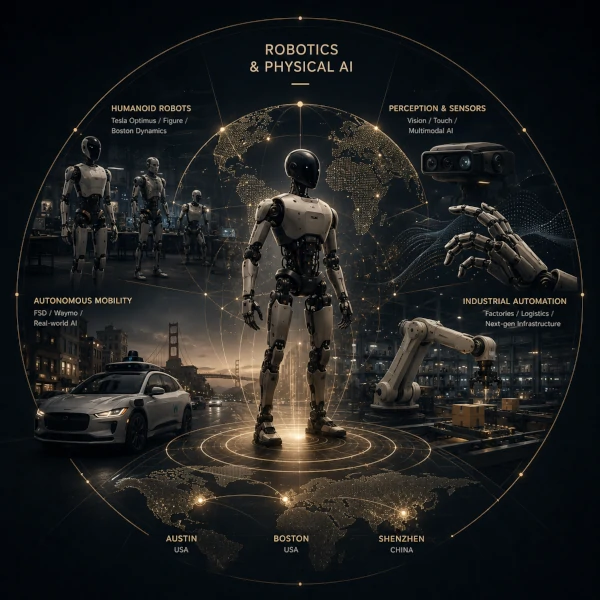
Humanoid robot development is shifting beyond mere aesthetics to infrastructure challenges: How can robots be adapted to spaces designed for humans? By examining Tesla's Optimus, Boston Dynamics' Atlas, Agility Robotics' Digit, operational tests by Figure AI, and engineering insights from IEEE papers, this article clarifies why humanoid robots are chosen despite alternatives.
Technology Mystery Disclosure
The Manhattan Project Left More Than Just Nuclear Weapons: A Blueprint for National Mobilization of Technology
This article reexamines the Manhattan Project not only as a history of nuclear weapons development but also as an archetype of massive state-led technology projects. Drawing on public archives from the US Department of Energy, RAND’s analyses of AI national security, and Oppenheimer’s public records, it outlines the commonalities and unresolved differences with current AI national strategy debates.
Foundation Models
Why Can't AI Companies Stop Competing Over Benchmarks?
Competition over large language model performance has entered a stage where single benchmarks no longer capture true capabilities, as shown by multifaceted evaluations like Stanford CRFM’s HELM and the Stanford AI Index.
Foundation Models
When AI Companies Waver Between Openness and Closure, What Emerges Is Not Ideology but Dynamics
This article explores why AI companies fluctuate between open-source and closed models amid intensifying competition and security concerns. By examining U.S.-China geopolitics, policy debates, and differences in model openness design, it frames this tension not as idealism but as a dynamic interplay of national strategy, capital, and trust.
Foundation Models
LLMs Seem Correct, But What Happens to That Subtle Feeling of Unease?
This article reframes decision support using LLMs not merely as a fight against hallucinations but through the lens of handling 'discomfort with assumptions.' Drawing on intuition research by Kahneman and Klein, experiments on AI-augmented decision-making, a review of LLM-assisted decisions, and types of intuition that detect AI’s limits, it examines the essential role human judgment must retain.
Foundation Models
The Tremors at Fuji TV Might Signal a Shift in the Backbone of the Video Industry
This archival article analyzes the crisis at Fuji TV not as an isolated scandal, but as a structural change intersecting television advertising shrinkage, shifts in viewing time, the rise of YouTube and VOD, and democratization of video production through generative AI. It connects governance issues at broadcasters with the evolving value framework of the video industry.