 Industrial Technology Correspondent
The discussion about robotics in industry has centered on displacement for years.[3][8] In practice, however, the upheaval often begins elsewhere: where shifts can no longer be fully staffed, where physically demanding work is hard to recruit for, and where each additional task slows the production line. Exactly for these reasons, Physical AI is It does not primarily promise a new era of autonomy, but rather a very old industrial function: closing gaps left by people falling out of the system.[1][4][10]
Several recent studies and company examples demonstrate how this shift is concretizing.[1][3][6] BMW tested humanoid robots from the company Figure at its Spartanburg plant to prepare for future production applications; according to the company, the focus was on autonomous tasks in a real manufacturing environment.[2] Even before, the same site had a pioneering role in direct human-robot collaboration in serial production.[5] The key takeaway is sober: the robot does not automatically replace a job, but takes over a narrowly defined step in an existing takt time.
This logic is especially important in automobile manufacturing because processes are rarely automated as a whole. Often it involves recurring, ergonomically unfavorable, or precision-critical manipulations that are hard to cover with classical robotics. Consultants and industry forums increasingly describe Physical AI as a system of perception, adaptation, and coordination: machines sense their surroundings, respond to deviations, and dynamically allocate tasks.[1][3][6] This is more than just a stronger robotic arm. It is a different mode of operation, where software, sensors, and mechanics move closer together.
The economic incentive thus lies not in the show, but in availability. A plant can scale up a robot more easily than find additional highly specialized shift workers. Deloitte points to gaps in training, safety, and cybersecurity; BCG therefore classifies Physical AI into developmental stages and emphasizes that companies must distinguish between systems actually ready for deployment and impressive demonstrators.[3][6] For industry this is not an academic point. Industrial adoption depends on reliability more than novelty. Reports also point out that humanoid robots, while considered the next frontier, still depend economically on many conditions for scaling.[3][9]
The World Economic Forum also now argues far more strongly in favor of human-centered collaboration.[1][8][10] In its recent publications on industrial operations, it describes adaptive cooperation, where systems consider load, movement, and risk while redistributing tasks between humans and machines.[1] This is relevant for practice because it steers the debate away from the replacement model. The machine is not supposed to completely push the human out of the process; rather, the machine should step in where the human gets fatigued, is endangered, or simply For the factory this means renegotiating division of labor, not abolishing it.
Despite this clearer narrative, much remains unconfirmed. Not every demo in a manufacturing environment is reliable production, and not every successful test indicates robustness over weeks, months, or with changing parts.[2][3][6] It also remains open how quickly humanoid systems become economically viable compared to specialized industrial robots, which are often less flexible but significantly more mature.[3][6][9] A clean assessment would require data on failure rates, maintenance effort, cycle times, safety incidents, and the question of how much human supervision remains necessary.
Precisely here the labor debate becomes more precise. The essential question is no longer just whether robotics eliminates jobs, but what kind of work in aging industries can still be reliably staffed. This is especially relevant in Europe, where many production sites face demographic pressures while simultaneously fulfilling high demands for quality, safety, and regulation.[4][8][10] If robots gain a foothold in such environments, it is mainly as a response to shortages of people, time, and physical capacity—not as an abstract symbol of technological superiority.
As machines increasingly undertake individual subtasks, the demand rises for operation, monitoring, exception handling, and system integration.[1][8] The WEF papers on Physical AI link this with roles in data analysis, robotics teams, and collaborative work between humans and machines.[1][4][7][8] For businesses, this means less debate over the either/or between human and robot, and more about the design of interfaces, safety zones, and responsibilities. The challenge is rarely the model itself. It is integration.
For industrial policy in Germany and Europe, this development is therefore more than another robotics topic. It touches productivity, skilled labor security, and the question of how manufacturing can be organized under the pressure of demography and resilience The decisive factor will be which applications move from testing into repeatable practice and which serve only as reference cases.[2][3][6] The robust finding for the moment reads: Physical AI is not primarily strong where it impresses people. It is strong where it takes on work for which hardly anyone can be found anymore. That makes it worth watching in the coming years.
References
References
Small numbered tags in the article body point to the sources below.
- [PDF] Intelligent Industrial Operations Outlook 2026 | World Economic Forum
- Successful test of humanoid robots at BMW Group Plant Spartanburg
- [PDF] Tech trends 2026 - Deloitte
- [PDF] Artificial Intelligence and the Future of Entry-Level Work
- Innovative human-robot cooperation in BMW Group Production.
- How Physical AI Is Reshaping Robotics Today | BCG
- Educating a future workforce that will match AI disruption | World Economic Forum
- [PDF] Physical AI: Powering the New Age of Industrial Operations
- [PDF] Impact Series 14: AI Gets Physical - Barclays Investment Bank
- Physical AI in Industrial Operations
PICKUP ARTICLES
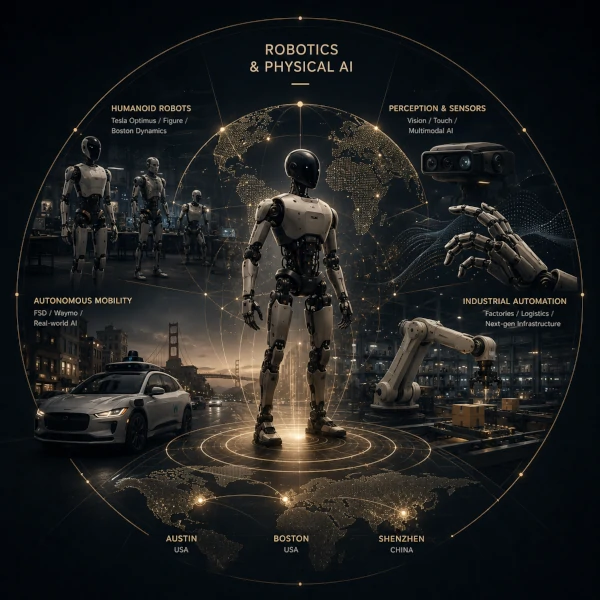 Robotics & Physical AI
Are Humanoid Robots the Fastest Route to Adapting the World to Humans?
Robotics & Physical AI
Are Humanoid Robots the Fastest Route to Adapting the World to Humans?